Wednesday, January 21

L-O-V-E, Rakuwa! Rakuwa!

So I was looking into this cabinet last night and found a picture of Rukawa and Hanamichi. I bought that picture when I was on the sixth grade..... it was during that time was SLAMDUNK was a hit among the elementary students.....

Though he's just an anime character.... I had a crush on him before....... HAHAHAHAHA! weird!

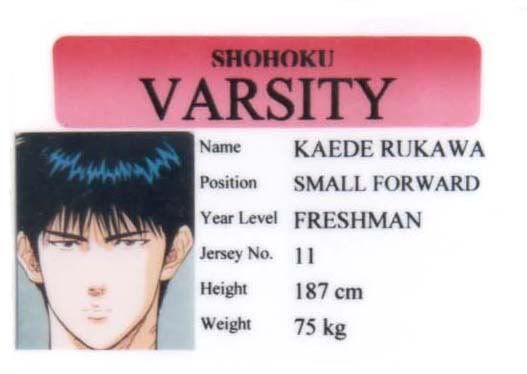
He's full name is Kaede Rukawa, member of his school's basketball varsity. I found his "varsity I.D." on the net:


I won't forget those three girls who used to cheer during his games. Their cheer goes like this: L-O-V-E Rukawa! Rukawa!


here's a better photo of Kaede

Sunday, January 18

what does HALLYU mean?

Hallyu is a new term which some Korean marketing genius probably came up with in a boardroom somewhere. Hallyu was invented to increase tourism and raise the profile of Korea in the world.The term 'Hallyu' means the love for Korean pop culture, or the appreciation of all things Korean. Hallyu began roughly 5 years ago when the rest of Asia discovered Korean soap operas. One of the breakthrough dramas was a series called Winter Sonata starring Choi Ji Woo and Bae Young-Joon. After that, more Korean dramas saw their way to foreign shores and Korean films and music started to follow suit. Korean marketing people started to see a Korea-centric trend flowing throughout Asia Hawaii and even in parts of Russia. They dubbed this flow "The Korean Wave" or Hallyu.

credit to: seoulstyle.com


now i know......... I'm suffering of Hallyu..... No. No. Not suffering.

It isn't bad to say that I'm suffering from it.......I mean........ experiencing Hallyu. Hee hee ;)

Saturday, January 17

Hanbok Souvenirs


Don't forget to buy these souvenirs before leaving Korea! Check the Tourist Souvenir Shop next to the Insadong’s Tourist Information Center.

These miniature Hanbok items come in all types of Hanbok including royal court Hanboks, Daejanggeum (Korean drama, Jewel in the Palace) -type Hanboks, and ceremonial Hanboks. Also, the dolls in Hanbok range from moderate to top quality high-priced dolls for doll-collectors.

Prices:
Dolls in Hanbok: ₩20,000~40,000
Framed Hanbok: ₩35,000~45,000

Or if you want to buy a Hanbok for you to wear, check this places:
(동대문) Dongdaemun Market:
Doosan Tower, located at Seoul Dongdaemun Market, has a marriage-essentials complex on the 7th floor, offering not only Hanboks, but bedding, decorative ornaments, and more. You can also take care of your shopping for trendy fashion-wear all at Doosan Tower. Business hours begin at 10am and end at 2am, so it allows you to shop late at night if you are busy during the day.

Directions:
Take Subway Line #2, 4, or 5 to Dongdaemun Stadium Station, and go out of Exit #14. Walk toward Dongdaemun for about 200m; located to the left of Doosan Tower.

(광장) Gwangjang Market:
Gwangjang Market is well known for its long tradition and history in the Hanbok-making business, and as it is a traditional type of market, it might not be the most convenient place to shop, but you can get the best deals Seoul has to offer in terms of Hanboks. You can also see what a traditional Korean market is like, and have fun bargaining for items you want to buy.
About 600 Hanbok shops line the first and second floors, with a wide range of prices depending on the material, embroidery and design. If you are looking for the best deal, then Gwangjang Market is the place for you. Each shop has its own business hours, but most shops usually open sometime between 6~8am and close somewhere around 7pm. All shops are closed on Sundays.

Directions:
Take Seoul Subway Line #1 to Jongno 5-ga Station and go out of Exit #8; it’s a 2 to 3-minute walk from the station exit.

Currency exchange rates as of January 17 2009 (Yahoo! Finance):
1US$ - 1351.8₩
1Php - 28.6854₩


text and photos from: english.visitkorea.or.kr

sa school:

hindi lahat ng tahimik ay nakikinig.


-randy

Chingu (Stained Glass OST) - Lee Dong Gun

paraman bwado nuni bu-syeot-do
noye ku nunbit naneun kiokhae
aju kinagin shigani hullogatjiman
occhom irohke hanado byeonhamomnunji

kugungori-neun nae ma-meun non algo-issulkka
amuronmaldo mothago utgimanha-neun no
ojing noma-neul kanchor-hi kidaryowatda-myeon
no-neun midulsu optketji ku seworul

otton insado osae-khagetji
kumankum uri koborin-golkka
uri hamkkehan ku shijoldo nae-bo-myeonso
nodo kakku-meun nae saenggak hae-ju-om-neunji

shijakhalsuman itda-myeon olmana choh-ulkka
hanado namkiji-anhko modu da jultende
kuttaen nomuna oryoso hae-julsu opsotdon
no-reul wihae chonbihae-un nae sara-ngeul

sesange tae-ona cho-um saranghaetdon
arumdaun gu so-nyeo-rul nan kiokhae
otton mosuburo otton saranguro
sarawatdon goni…

shijakhalsuman itda-myeon olmana choh-ulkka
hanado namkiji-anhko modu da jultende
kuttaen nomuna oryoso hae-julsu opsotdon
no-reul wihae chonbihae-un nae sara-ngeul

download this song!

*to download, right click the link then click "save link as"

credit to: kreah-craze.com, koreanentertainmentlovers.blogspot.com


if anyone knows the English translation, feel free to comment it here! :D thanks!

Thursday, January 15

Aanhin mo ang lalakeng gwapo, kung mas malandi naman sa 'yo.


-randy

the BANANA diet

As elsewhere, people in Japan who are trying to lose weight gather together on internet forums and social networking sites to pick up diet tips and give each other support. Recently on Mixi, one of the most popular social networking sites in Japan, the diet musings of one of the members and the enthusiastic contributions of others in the community coalesced to produce a new and simple diet program that has jumped into the mainstream Japanese media and resulted in three books and many magazine articles. This diet was dubbed the Asa Banana Diet. Japan is known for kaizen, the gradual refinement and improvement of manufacturing and other processes, and the Asa Banana Diet is in effect Japan’s kaizen of a diet classic, the Banana Diet.

Learn the diet:
Rule #1: Eat 1-2 bananas before each meal... minimum of 3 times a day.

Very simple, huh? Not much to think about. If you eat, you're going to eat 1-2 bananas before your meal. Practical, easy, healthy, and not much to remember.

Before breakfast, eat 2 bananas. Before lunch, eat 2 bananas. Before dinner, eat 1 banana. So you eat 5 total bananas a day.

Rule #2: Eat whatever you want for meals.

This rule is simple... eat whatever you want, just as long as you eat 2 bananas before breakfast, 2 bananas before lunch, and 1 banana before dinner. Obviously eating healthier than normal would help your weight loss efforts even more, but it's not 100% necessary.

Bonus Rule: You can replace 1 banana with an apple before breakfast and lunch.

As mentioned, you can replace a banana with an apple before breakfast and lunch. This is to help relieve possible boredom. Nothing more.

*I think it's an expensive diet for Japan. My betsfriend's dad works with a Japanese and he mentioned that bananas are sold in high price in Japan.....

text from: morningbanana.com, ezine articles

to know how much weight, you'd be able to loose, check this article from TIME.

Monday, January 12

light of the world

A small boy forgot his lines in the Sunday school presentation. His mother sat in the front row and tried to prompt him by gesturing and silently forming words with her lips. It was no use. The boy's memory went blank.

Finally she leaned forward and whispered his cue: "I am the light of the world."

With broad smile and beaming confidence, the child sad in a loud, clear voice: "My mother is the light of the world."


from: kerygma