
Expressing emotion:
(^_^) = smile
(^o^) = laughing out loud
d(^_^)b = thumbs up (not ears)
(T_T) = sad (it's a crying face)
(-.-)Zzz = sleeping
(Z.Z) = sleepy person
\(^_^)/ = cheers, hurrah
(*^^*) = shyness
(-_-); = sweating (as in ashamed)
(^_^);; = sorry! my mistake
(?_?) = nonsense, i don't know
(^_~) = wink
(o.O) = surprise
v(^_^)v = victory
(>^_^)> = hugging
(>^_^)> <(^_^<) = hugging each other (^o^)
Animals:
>))))'> = a fish
>))))'><'((((< = kissing fish (^o^)
<')++++< = a fish bone
Vm~ = a fox
() () = a rabbit
(^.^)
(^(oo)^) = a pig
('v')
(( )) = a bird
-"-"-
()()() ()()()
(-(-(-.-)-)-) = rabbit gang
= = = = :} = a snake
(=^_^=) = cat
Things:
@}-;--`-- = a rose
>(/////)< = a candy
=]::::::> = a sword
---E = a fork
credit to: blogger.xs4all.nl
Showing posts with label korea. Show all posts
Showing posts with label korea. Show all posts
Monday, May 25

Sunday, February 22
My friend Stephanie gave me this cute cellphone accessory ans told me that it reminded her of me (because they know I'm very enthusiastic about Korea...hahahaha!):

thanks Steph!!! :D

thanks Steph!!! :D
Sunday, February 1
Haven for Shoppaholics
It’s easy to assume that Koreans are not night creatures, but that is far from the truth. Not only are there many Korean restaurants open 24 hours, but you can even shop all night long if you want to! Many places don’t even open until 8PM and you can shop until the sun comes up. Alot of high school students will go social shopping with their friends at night instead of going out to a bar or night club. Generally though, these all night malls are for wholesalers, so you get a cheaper price if you shop at night. (If you are only buying one item at a time, the discount is not that great, but it's still cheaper than normal.) You would be tempted to think that these places are not crowded since it’s the middle of the night, but in Tongdaemun for example, it’s practically impossible to find parking or a taxi at some of these establishments. At midnight, some of these malls are jam-packed with store owners carrying huge bags of booty for their shops. There will also be the occasional Japanese, Chinese or Singaporean tourist there.You can come out of the clubs and go drunk shopping, or you can get off from a late night at work and go shopping! Is there anywhere else in the world where can you shop till the wee hours? Cool!
credit to: seoulstyle.com
credit to: seoulstyle.com
Pojangmacha (보장마차)

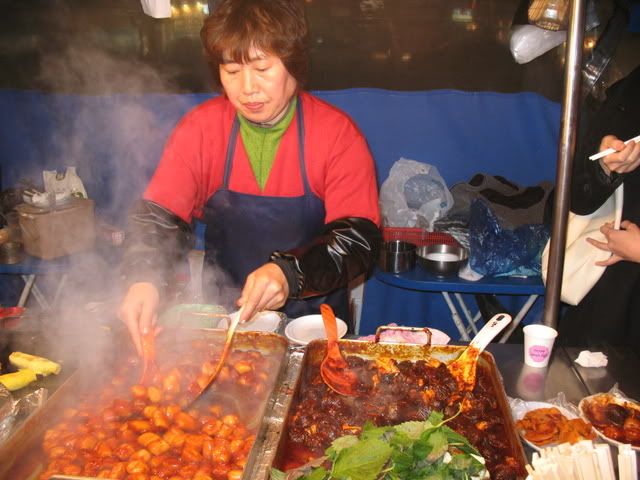
Mmmmm!!! I wonder what ajumma's cooking...
If you're addcited to Kdrama, I'm sure you've seen this stalls where Koreans drink bottle after bottle of sojus.
A pojangmacha is typically a restaurant on wheels. People cook food out of their trucks or vans and construct a make-shift restaurant with a tent. The walls of the restaurant are made with heavy duty plastic. A pojangmacha usually has plastic tables and chairs and has a raw charm about it. During winter months, pojangmacha owners may use kerosene heaters to warm the inside of the tent. While pojangmachas started out as a place to have a movable feast, some took the idea a bit further and decided to turn their tented restaurant into a permanent establishment. There are a few places in Apkujong near the Hak-dong intersection that are car garages by day and pojangmachas by night. There are several large, permanent pojangmachas in Hongdae where university students can snack after a night out clubbing. There are also entire streets of pojangmachas scattered throughout Seoul.
Don’t expect a nutritious three course meal at a pojangmacha, instead you will find all manner of snacks: pork dumplings (mandu), korean pizza known as chon, rice cakes covered in chili sauce (ddopoki), fish sticks, chicken liver sticks etc..
Why are pojangmachas so ubiquitous in Korea? Firstly, the price is right. The food at pojangmachas are often very cheap, since owners don’t have to pay exorbitant rents. Secondly, the atmosphere is lively and convivial. Pojangmachas are most often found clustered in areas where people are shopping, drinking and partying. You can go in there completely drunk, act loud and obnoxious and still manage to get a nice greasy meal to soak up the booze. If you want to continue drinking, most pojangmachas serve the alcoholic jet-fuel known as soju! In summary, pojangmachas are friendly places you can get cheap greasy snacks and chat with the owners or people next to you. It’s the fun atmosphere which makes pojangmachas a popular place for casual socializing.
credit to: seoulstyle.com,
Sunday, January 18
what does HALLYU mean?
Hallyu is a new term which some Korean marketing genius probably came up with in a boardroom somewhere. Hallyu was invented to increase tourism and raise the profile of Korea in the world.The term 'Hallyu' means the love for Korean pop culture, or the appreciation of all things Korean. Hallyu began roughly 5 years ago when the rest of Asia discovered Korean soap operas. One of the breakthrough dramas was a series called Winter Sonata starring Choi Ji Woo and Bae Young-Joon. After that, more Korean dramas saw their way to foreign shores and Korean films and music started to follow suit. Korean marketing people started to see a Korea-centric trend flowing throughout Asia Hawaii and even in parts of Russia. They dubbed this flow "The Korean Wave" or Hallyu.
credit to: seoulstyle.com
now i know......... I'm suffering of Hallyu..... No. No. Not suffering.
It isn't bad to say that I'm suffering from it.......I mean........ experiencing Hallyu. Hee hee ;)
credit to: seoulstyle.com
now i know......... I'm suffering of Hallyu..... No. No. Not suffering.
It isn't bad to say that I'm suffering from it.......I mean........ experiencing Hallyu. Hee hee ;)
Saturday, January 17
Hanbok Souvenirs


Don't forget to buy these souvenirs before leaving Korea! Check the Tourist Souvenir Shop next to the Insadong’s Tourist Information Center.
These miniature Hanbok items come in all types of Hanbok including royal court Hanboks, Daejanggeum (Korean drama, Jewel in the Palace) -type Hanboks, and ceremonial Hanboks. Also, the dolls in Hanbok range from moderate to top quality high-priced dolls for doll-collectors.
Prices:
Dolls in Hanbok: ₩20,000~40,000
Framed Hanbok: ₩35,000~45,000
Or if you want to buy a Hanbok for you to wear, check this places:
(동대문) Dongdaemun Market:
Doosan Tower, located at Seoul Dongdaemun Market, has a marriage-essentials complex on the 7th floor, offering not only Hanboks, but bedding, decorative ornaments, and more. You can also take care of your shopping for trendy fashion-wear all at Doosan Tower. Business hours begin at 10am and end at 2am, so it allows you to shop late at night if you are busy during the day.
Directions:
Take Subway Line #2, 4, or 5 to Dongdaemun Stadium Station, and go out of Exit #14. Walk toward Dongdaemun for about 200m; located to the left of Doosan Tower.
(광장) Gwangjang Market:
Gwangjang Market is well known for its long tradition and history in the Hanbok-making business, and as it is a traditional type of market, it might not be the most convenient place to shop, but you can get the best deals Seoul has to offer in terms of Hanboks. You can also see what a traditional Korean market is like, and have fun bargaining for items you want to buy.
About 600 Hanbok shops line the first and second floors, with a wide range of prices depending on the material, embroidery and design. If you are looking for the best deal, then Gwangjang Market is the place for you. Each shop has its own business hours, but most shops usually open sometime between 6~8am and close somewhere around 7pm. All shops are closed on Sundays.
Directions:
Take Seoul Subway Line #1 to Jongno 5-ga Station and go out of Exit #8; it’s a 2 to 3-minute walk from the station exit.
Currency exchange rates as of January 17 2009 (Yahoo! Finance):
1US$ - 1351.8₩
1Php - 28.6854₩
text and photos from: english.visitkorea.or.kr
Saturday, January 10
Gache: BEAUTIFUL in BRAIDS
 Facts:
Gache is a big wig in braids.
It usually weighs 3 - 4 kilograms.
It takes 6-7 years to make a Gache.
To Koreans, wearing these big and heavy wigs makes them look more beautiful and elegant.
At first (I'm talking about the first time korean drama was aired in the Philippines - I think that was 2003) I found it awkward....
Monday, January 5
학생 is back to school
I'm back to school today.
And and maybe I'm currently standing under the heat of the sun, singing the national anthem or sitting on my chair listening to whatever is being discussed right now.
I just wish this is how our uniform looked like:

I am Sam cast
And and maybe I'm currently standing under the heat of the sun, singing the national anthem or sitting on my chair listening to whatever is being discussed right now.
I just wish this is how our uniform looked like:
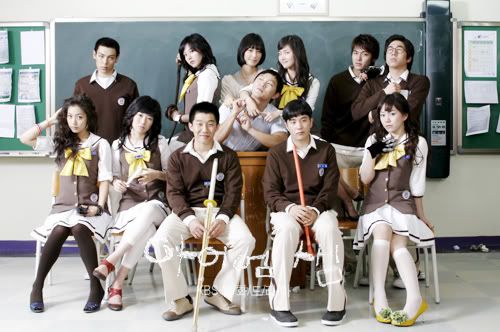
I am Sam cast
Tuesday, December 30
Soju (소주)
I'm sure you've already seen this green bottle in korean drama and movies ;)

Soju is a distilled beverage native to Korea. Most brands of modern soju are made in South Korea. Though traditionally made from rice, most major brands supplement or even replace the rice with other starches such as potato, wheat, barley, sweet potato, or tapioca (called dangmil in Korean). Soju is clear in color and typically varies in alcohol content from about 20% to about 45% alcohol by volume (ABV), with 20% ABV being most common. Its taste is comparable to vodka, though often slightly sweeter because of the sugars added in the manufacturing process.
Etiquette when drinking Soju:
Soju is usually drunk in group gatherings while eating, unmixed and portioned into individual shot glasses. It is against traditional custom in Korea to fill one's own glass. Instead, it must be filled by someone else at the table. This promotes a spirit of thoughtfulness and camaraderie.
In Korean culture, using two hands to offer and accept items is considered an act of respect. Accordingly, if one's glass is going to be filled by a superior, one should hold the glass with both hands. Similarly, when pouring soju for an elder, one holds the bottle with both hands.
To pour a drink, hold the bottle in the right hand with the left hand touching the right forearm or elbow; this peculiar arm position originated from the practice of holding back the sleeve of the hanbok so that it wouldn't touch the table or the food.
Similarly, when receiving a drink, rest the glass in the left palm and hold it with the right hand, perhaps bowing the head slightly to show additional respect. You can also hold the glass using the same hand positions as when pouring. Pouring and receiving with just the right hand by a senior, or between equals, is common in normal situations.
Koreans often say "one shot", a challenge to everyone in the group to down their glass in one gulp.
A glass should not be refilled unless completely empty and should be promptly refilled once empty; it is considered rude to not fill someone else's glass when empty.
Some special rules apply when drinking with someone of much higher status, i.e. greater age or rank. When drinking in front of elders (people older than you), the junior is expected to turn away from the elder first. Drinking the shot while directly facing the elder is considered disrespectful.
On occasions, an elder gives an empty soju shot glass (usually his/hers) to an equal or junior. A junior may also offer an empty glass to a senior after they have established a closer relationship.
Giving the glass implies that the person is going to fill it and wants the receiver to drink it. It is not obligatory to finish the drink immediately, but it is impolite to place the glass on the table without at least pretending to drink from it.
After finishing the entire glass, it should be returned and refilled. It is not necessary to return it immediately, but holding it for a long time is considered rude, as it deprives the giver of his glass.
Among friends of equal social status, it is not necessary to use both hands while pouring or receiving a drink, but may be done out of habit or politeness, or if the situation is considered a particularly formal one.
trivia:Soju was entered into the online Merriam-Webster Dictionary in 2008 and will be included in the printed edition September 1, 2008. Soju is now one of only a handful of Korean words that have entered the English lexicon (others being "kimchi", "taekwondo", and "hangul"). Merriam-Webster dates the word's appearance in the American English lexicon at 1978.
for Soju recipes visit this site
text from: wikipedia.com

Soju is a distilled beverage native to Korea. Most brands of modern soju are made in South Korea. Though traditionally made from rice, most major brands supplement or even replace the rice with other starches such as potato, wheat, barley, sweet potato, or tapioca (called dangmil in Korean). Soju is clear in color and typically varies in alcohol content from about 20% to about 45% alcohol by volume (ABV), with 20% ABV being most common. Its taste is comparable to vodka, though often slightly sweeter because of the sugars added in the manufacturing process.
Etiquette when drinking Soju:
Soju is usually drunk in group gatherings while eating, unmixed and portioned into individual shot glasses. It is against traditional custom in Korea to fill one's own glass. Instead, it must be filled by someone else at the table. This promotes a spirit of thoughtfulness and camaraderie.
In Korean culture, using two hands to offer and accept items is considered an act of respect. Accordingly, if one's glass is going to be filled by a superior, one should hold the glass with both hands. Similarly, when pouring soju for an elder, one holds the bottle with both hands.
To pour a drink, hold the bottle in the right hand with the left hand touching the right forearm or elbow; this peculiar arm position originated from the practice of holding back the sleeve of the hanbok so that it wouldn't touch the table or the food.
Similarly, when receiving a drink, rest the glass in the left palm and hold it with the right hand, perhaps bowing the head slightly to show additional respect. You can also hold the glass using the same hand positions as when pouring. Pouring and receiving with just the right hand by a senior, or between equals, is common in normal situations.
Koreans often say "one shot", a challenge to everyone in the group to down their glass in one gulp.
A glass should not be refilled unless completely empty and should be promptly refilled once empty; it is considered rude to not fill someone else's glass when empty.
Some special rules apply when drinking with someone of much higher status, i.e. greater age or rank. When drinking in front of elders (people older than you), the junior is expected to turn away from the elder first. Drinking the shot while directly facing the elder is considered disrespectful.
On occasions, an elder gives an empty soju shot glass (usually his/hers) to an equal or junior. A junior may also offer an empty glass to a senior after they have established a closer relationship.
Giving the glass implies that the person is going to fill it and wants the receiver to drink it. It is not obligatory to finish the drink immediately, but it is impolite to place the glass on the table without at least pretending to drink from it.
After finishing the entire glass, it should be returned and refilled. It is not necessary to return it immediately, but holding it for a long time is considered rude, as it deprives the giver of his glass.
Among friends of equal social status, it is not necessary to use both hands while pouring or receiving a drink, but may be done out of habit or politeness, or if the situation is considered a particularly formal one.
trivia:Soju was entered into the online Merriam-Webster Dictionary in 2008 and will be included in the printed edition September 1, 2008. Soju is now one of only a handful of Korean words that have entered the English lexicon (others being "kimchi", "taekwondo", and "hangul"). Merriam-Webster dates the word's appearance in the American English lexicon at 1978.
for Soju recipes visit this site
text from: wikipedia.com
Monday, December 29
South Korean Etiquette
There are some quite interesting dining rules that are followed as regards South Korean etiquette. If you'd decide to visit Korea, these would be a great help for sure:
- South Korean etiquette involves some very strict rules regarding who should sit at specific spots at the dinner table and it is best to wait till you are told where to sit. Don't commit a social blunder by making a dash for the empty seat beside the pretty lady.
- According to the Korean etiquette the eldest person at the table eats first. So don't pounce on your food as soon as he/she arrives, however famished you might be.
- Practice saying "no" when dining out in South Korea. This is because South Korean etiquette dictates that the first offer of the second helping should always be refused. (this a bit confusing...... i can't rephrase it...)
- Don't give rise to the frowns and the raised eyebrows by pointing your chopsticks.
- Don't leave your chopsticks sticking out of the rice bowl. This is a definite no-no, as this is funeral ritual.
- However comfortable it may seem, don't use your hands to pick up food.
- Table manners in South Korea say that you don't leave anything on your plate. Indicate that you are full by keeping your chopsticks on the chopstick rest or on the table.
- Etiquette in South Korea says that you pour each other drinks. Understandably so, for Korea is a generous and giving society where the people don't just help themselves.
- If someone senior to you is extending you a drink, you should adhere to South Korean etiquette and accept it with both hands cupped on the glass. More importantly, you are expected to drink with your head turned sideways, away from your senior.
- This is for the juniors. Ensure that you keep the glasses of your seniors always full; a good way of being in their good books.
There are some other do's and don'ts in South Korea that would help you in your dealings, both personal and professional, with the Korean locals. Here:
- Always remove your shoes when entering a South Korean house. There are also some restaurants where you are supposed to enter bare feet.
- Being half-an-hour late is acceptable in South Korea. Now this is probably one thing that is sure to bring on the smiles, especially for those flouting the hands of the watch is a habit.
revised post from: asiarooms.com
- South Korean etiquette involves some very strict rules regarding who should sit at specific spots at the dinner table and it is best to wait till you are told where to sit. Don't commit a social blunder by making a dash for the empty seat beside the pretty lady.
- According to the Korean etiquette the eldest person at the table eats first. So don't pounce on your food as soon as he/she arrives, however famished you might be.
- Practice saying "no" when dining out in South Korea. This is because South Korean etiquette dictates that the first offer of the second helping should always be refused. (this a bit confusing...... i can't rephrase it...)
- Don't give rise to the frowns and the raised eyebrows by pointing your chopsticks.
- Don't leave your chopsticks sticking out of the rice bowl. This is a definite no-no, as this is funeral ritual.
- However comfortable it may seem, don't use your hands to pick up food.
- Table manners in South Korea say that you don't leave anything on your plate. Indicate that you are full by keeping your chopsticks on the chopstick rest or on the table.
- Etiquette in South Korea says that you pour each other drinks. Understandably so, for Korea is a generous and giving society where the people don't just help themselves.
- If someone senior to you is extending you a drink, you should adhere to South Korean etiquette and accept it with both hands cupped on the glass. More importantly, you are expected to drink with your head turned sideways, away from your senior.
- This is for the juniors. Ensure that you keep the glasses of your seniors always full; a good way of being in their good books.
There are some other do's and don'ts in South Korea that would help you in your dealings, both personal and professional, with the Korean locals. Here:
- Always remove your shoes when entering a South Korean house. There are also some restaurants where you are supposed to enter bare feet.
- Being half-an-hour late is acceptable in South Korea. Now this is probably one thing that is sure to bring on the smiles, especially for those flouting the hands of the watch is a habit.
revised post from: asiarooms.com
Sunday, December 28
Samtaeguk - 삼태극

A samtaeguk is a traditional Korean pattern and visual image which represents Korea. This pattern is widely used as decoration on fans, gates of Korean-style homes, artifacts, and folk crafts.
text from: olympic.org
photo from: wikimedia.com
Thursday, December 18
what a lucky day!
I was then sitting on the passenger van waiting..... then two Koreans came.... and one of them sat beside me.... :)
We talked and he asked things like; what school do you go in..... what year level are you in..... what school are you planning to go to on college....... how many are your siblings....... if I understand CNN news (that's because he was boasting that his daughter could understand English..... and even those on CNN...... HAHAHAHAHAHA) If I could completely understand American movies....... if I understood the song playing on the radio (that's because the song was English again...)what's my mom and dad's work.......
His English was a bit distorted that makes it a little hard to understand...... like he pronounces college as "ko-lee-gee" and CNN as "shi-en-en"........
but still of course, it was nice to meet and speak to a Korean ;D
We talked and he asked things like; what school do you go in..... what year level are you in..... what school are you planning to go to on college....... how many are your siblings....... if I understand CNN news (that's because he was boasting that his daughter could understand English..... and even those on CNN...... HAHAHAHAHAHA) If I could completely understand American movies....... if I understood the song playing on the radio (that's because the song was English again...)what's my mom and dad's work.......
His English was a bit distorted that makes it a little hard to understand...... like he pronounces college as "ko-lee-gee" and CNN as "shi-en-en"........
but still of course, it was nice to meet and speak to a Korean ;D
Tuesday, December 16
Stained Glass (유리화 )

During their childhood, Dong-ju and Gi-tae are both abandoned by their real parents. In the orphanage, they grow up like brothers and become best friends. Ji-su transfers to the school, where Dong-ju and Gi-tae attended there. But at the same time, they both fall in love with her. While trying to get the ocarina, Dong-ju is caught in the river and is presumed drowned. A Japanese couple adopted him after he was being drowned in the river, Dong Ju became a heir to the corpotate throne. Gi-tae takes Dong-ju's place in Ji-su's affections and later become a couple. Twelve years later, Dong-ju returns to Korea as a Japanese gentleman, but his feelings for Ji-su begin to develop and his friendship with Gi-tae begin to unravel.
Genre: Melodrama, Romance
Network: SBS
cast:
Kim Ha Neul as Shin Ji Soo
Lee Dong Gun as Han Dong Joo / Yuichi Yamamoto
Kim Sung Soo as Park Ki Tae
official site
text from: DramaWiki
photo from: mountainapplecompany.com
Monday, December 8
the S-line secret
S-line, is how the Koreans describe a "coca cola-shaped body" or in short, sexy.
Chili is always a part of Korean food or "한식 (Hansik)". They call red peppers "고추(Gochu)". Red peppers are the main ingredient for their red pepper paste which is "고추장(Gochujang)", together with salt, water, fermented soybeans and sweet rice powder, and which is almost a part of every Hansik. Korean food is basically spicy. Aside from chili giving a spicy taste, chili relieves pain and breaks down fat, that makes it an ideal dietary food...... That's why most of korean females don't get fat.
Chili is always a part of Korean food or "한식 (Hansik)". They call red peppers "고추(Gochu)". Red peppers are the main ingredient for their red pepper paste which is "고추장(Gochujang)", together with salt, water, fermented soybeans and sweet rice powder, and which is almost a part of every Hansik. Korean food is basically spicy. Aside from chili giving a spicy taste, chili relieves pain and breaks down fat, that makes it an ideal dietary food...... That's why most of korean females don't get fat.
Friday, December 5
200 Pounds Beauty (Minyeo-neun georowo)
 So....... I decided to borrow something to watch from my friend..... and one of these was Two Hundred Pounds Beauty....... It was really nice. Really nice. I cried a lot..... specially at the end.... hahaha.....
Genre: comedy, romance
Starring:
앟중김 (Ahn Jung Kim)- Hanna
진모주 (Jin Mo Ju)- Sang Jun
from: imdb.com
photo from: yeehan.com
Plot summary:
Hanna who sings for Ammy(or Ammy lip syncs Hanna's voice when singing) falls in love with Sang Jun, manager of Ammy. But because Sang Jun doesn't notices her, decided to get a full body-plastic surgery. Due to the loss of Hanna, Sang Jun held auditions for a new one to lip sync for Ammy. Jenny finds out about the audition and tries out, and ends to be built up by Sang Jun as a new singing superstar. Sang Jun ends up discovering her true identity. Jenny reveals her true identity to the public in the last concert show on the movie.
Monday, December 1
Back from Baguio
Time Check: 11:59 am.
I'm already back from a two-day stay in Baguio.
First day:
We arrived at Baguio past nine am....... I stayed with mom at their meeting till 1 in the afternoon, then went to the place where we were to stay. We went out to make series of purchases at ukay-ukay stores in Baguio. HAHAHAHAHAHA We went home early to rest for the next day.
Second day:
We went out of the place where we stayed at ten..... We ate lunch at a Korean restaurant ( and that was Hodori-> ahjumma, ahjussi; jayoroun kwanggoreul jeoreul kamsahashipsio ;) ) at Session Road..... I ordered for Samgypsal which was thin pork that you fry in that built-in stove in the table and noodles (it's name started with something that rounded Ra------ i forgot already....) HAHAAHA we didn't know how to cook the Samgypsal that's why we just asked for the assistance of the waitress....... good thing she had a good relationship with customers.......... After lunch, we headed for SLU for my entrnace examinations that lasted until half past-three in the afternoon....... then went to SM Baguio after that.
Third day:
We went home.
And now, I don't know what to do for the exams tomorrow. Gosh.
I'm already back from a two-day stay in Baguio.
First day:
We arrived at Baguio past nine am....... I stayed with mom at their meeting till 1 in the afternoon, then went to the place where we were to stay. We went out to make series of purchases at ukay-ukay stores in Baguio. HAHAHAHAHAHA We went home early to rest for the next day.
Second day:
We went out of the place where we stayed at ten..... We ate lunch at a Korean restaurant ( and that was Hodori-> ahjumma, ahjussi; jayoroun kwanggoreul jeoreul kamsahashipsio ;) ) at Session Road..... I ordered for Samgypsal which was thin pork that you fry in that built-in stove in the table and noodles (it's name started with something that rounded Ra------ i forgot already....) HAHAAHA we didn't know how to cook the Samgypsal that's why we just asked for the assistance of the waitress....... good thing she had a good relationship with customers.......... After lunch, we headed for SLU for my entrnace examinations that lasted until half past-three in the afternoon....... then went to SM Baguio after that.
Third day:
We went home.
And now, I don't know what to do for the exams tomorrow. Gosh.
Friday, November 28
Overview: Hanbok
Women's hanbok is comprised of a wrap-around skirt and a jacket. It is often called chima-jeogori, 'chima' being the Korean word for skirt and 'jeogori' the word for jacket. Men's hanbok consists of a short jacket and pants, called 'baji', that are roomy and bound at the ankles. Both ensembles may be topped by a long coat of a similar cut called 'durumagi'. Hanbok worn today are patterned after those worn during the Confucian-oriented Joseon Dynasty (1392-1910). Yangban, a hereditary aristocratic class based on scholarship and official position rather than on wealth, wore brightly colored hanbok of plain and patterned silk in cold weather and closely woven ramie cloth or other high-grade, light weight materials in warm weather. Commoners, on the other hand, were restricted by law as well as finances to bleached hemp and cotton and could only wear white, pale pink, light green, gray or charcoal colors.
 Jeogori->The jeogori makes up the upper part of the hanbok. Men's jeogori is larger and simplistic while a woman's jeogori is rather short and characterized by curved lines and delicate decorations.
DongJeong->The dongjeong refers to a white collar attached along the rim of the neckline. It contrasts and harmonizes with the overall curve of the neck.
Otgoreum (Cloth Strings)->The otgoreum is a women's ornamental piece, which hangs vertically across the front of the chima.
Baerae (Jeogori Sleeve)->The baerae refers to the lower lines of the sleeve of either the jeogori , or the magoja (outer jacket). It features a circular line which is naturally curved, similar to the line of the eaves of the traditional Korean house.
Chima->The chima is the women's outer skirt. There are different kinds of chima: single-layered, double-layered, and quilted. Pul-chima refers to a chima with a separated back, whereas a tong-chima has a seamed back.

Durumagi->The durumagi is a traditional overcoat worn on special occasions over the traditional jacket and pants.
Baji->Baji refers to the lower part of the men's hanbok. . The roomy nature of the cloth is due to a design aimed at making the cloth ideal for sitting on the floor.
*Kkotsin->The kkotsin refers to silk shoes on which flower patterns are embroidered. They play an important role in completing the graceful line of the lower rim of the chima.
here are nice kkotsins:

texts from: asia-planet.net, freewebs.com
photos from: freewebs.com, flickr
 Jeogori->The jeogori makes up the upper part of the hanbok. Men's jeogori is larger and simplistic while a woman's jeogori is rather short and characterized by curved lines and delicate decorations.
DongJeong->The dongjeong refers to a white collar attached along the rim of the neckline. It contrasts and harmonizes with the overall curve of the neck.
Otgoreum (Cloth Strings)->The otgoreum is a women's ornamental piece, which hangs vertically across the front of the chima.
Baerae (Jeogori Sleeve)->The baerae refers to the lower lines of the sleeve of either the jeogori , or the magoja (outer jacket). It features a circular line which is naturally curved, similar to the line of the eaves of the traditional Korean house.
Chima->The chima is the women's outer skirt. There are different kinds of chima: single-layered, double-layered, and quilted. Pul-chima refers to a chima with a separated back, whereas a tong-chima has a seamed back.

Durumagi->The durumagi is a traditional overcoat worn on special occasions over the traditional jacket and pants.
Baji->Baji refers to the lower part of the men's hanbok. . The roomy nature of the cloth is due to a design aimed at making the cloth ideal for sitting on the floor.
*Kkotsin->The kkotsin refers to silk shoes on which flower patterns are embroidered. They play an important role in completing the graceful line of the lower rim of the chima.
here are nice kkotsins:

texts from: asia-planet.net, freewebs.com
photos from: freewebs.com, flickr
Subscribe to:
Posts (Atom)


